
Larder Beetle Control & Prevention
Do you have a beetle infestation in your home or business? Schedule a service with Plunkett’s Pest Control today!
Larder Beetle Pest Control
To solve your larder beetle problem, the Plunkett’s team:
- Finds the primary source of infestation and eliminates it, including locating the access points larder beetles used to get in
- Inspects all the food larder beetles may infest and the area you keep that food
- Disposes of infested food and helps you make those areas inaccessible going forward
- Applies targeted insecticide dust, spray, or residual aerosol to cracks, crevices, infected structural voids, and other at-risk areas to help prevent a recurrence
Schedule a service by filling out our form. We’ll solve your larder beetle problem quickly!
Larder Beetle Identification: Appearance & Behavior
Larder beetles (Dermestes lardarius) are a common stored product pest that are found all over the world. The name “larder beetle” refers to the fact that these beetles commonly infest cured meats and other stored provisions.
Larder beetle adults and larvae feed on all kinds of animal products including dried fish, ham, bacon, meats, cheese, and pet food. They may also occasionally feed on plant materials such as stored tobacco.
Adult Larder Beetle
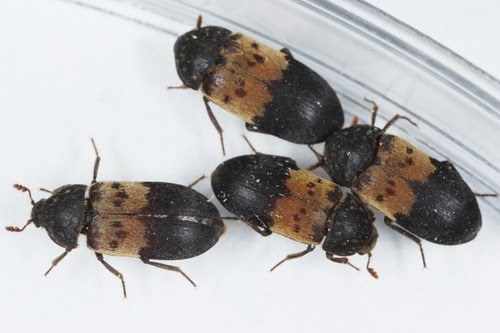
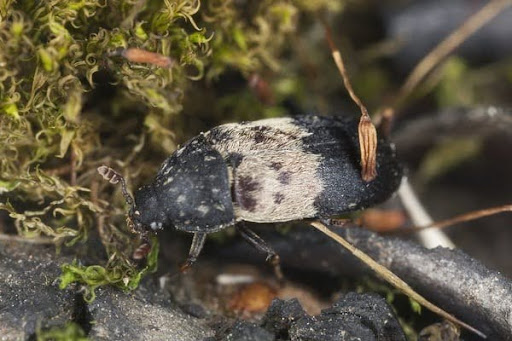
Adult larder beetles measure ¼ to ⅜ of an inch and are oval-shaped. Their bodies are dark brown to black with a large pale yellow or beige band on their wings. There are usually black spots dotted across this band. The underside of the beetle is covered in fine yellow hair.
Larder Beetle Larvae
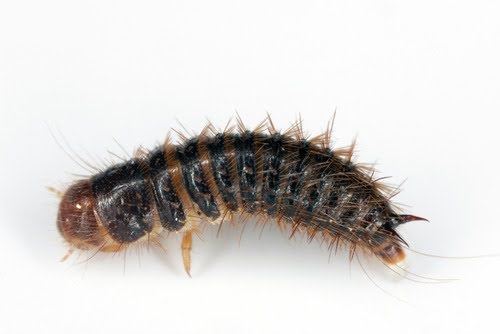
Larvae are ⅜ to ⅝” long, dark brown, and covered with long brown hairs. Larvae have 3 pairs of short legs and a pair of small spines (urogomphi) that curve back from their rear. Larvae bodies appear to have distinct body segments.
The beetle larvae inflict the most damage. They feed on stored food material and may also burrow into hard materials such as wood or corkboard in order to pupate in safety. Beetle adults don’t burrow but will feed on stored material. Both larvae and adults leave behind waste and shed skin frequently.
Larder Beetle Lifecycle
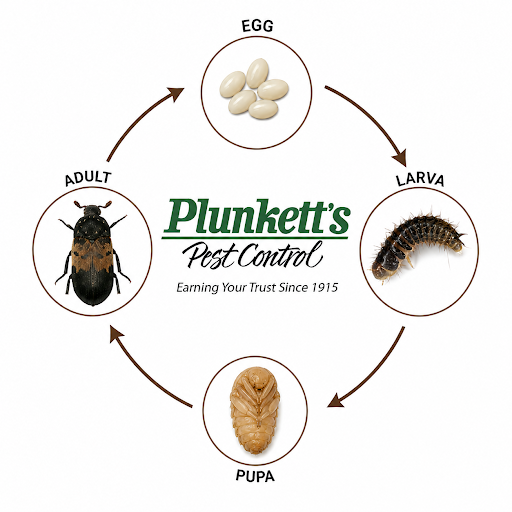
Larder beetles complete their full life cycle in 60 to 70 days, though warm, dry conditions can accelerate the process. Females lay anywhere from 100 to 800 eggs on or near food sources, and those eggs typically hatch within 12 days.
Larvae spend around 19 days feeding and growing through six or seven instars before pupating for about five days. Once adults emerge, they seek mates and new food sources to start the cycle again. While larder beetles usually reproduce once a year, favorable conditions can lead to more frequent breeding.
How to Get Rid of Larder Beetles: Contact Plunkett’s Pest Control
Our goal is to help you quickly and in the most cost-effective way. We make every effort to be with you ASAP, usually within a day or two.
Frequently Asked Questions
Do larder beetles bite?
Larder beetles don’t typically bite people. Adults are not aggressive and don’t feed on humans. However, the larvae have stiff, bristly hairs that can cause skin irritation or a mild rash in some people if they come into contact with them, which is sometimes mistaken for a bite. If you’re finding red marks or experiencing skin irritation alongside a larder beetle infestation, it’s the larvae, not the adults, that are most likely the cause.
Are larder beetles harmful to pets?
Larder beetles aren’t dangerous to cats or dogs. The beetles themselves pose no direct threat, and dry pet food is simply one of their preferred food sources. That said, pets can occasionally ingest larvae when eating from an infested bag of food. This isn’t toxic but it’s obviously not ideal. The more common concern is that a pet food bag stored in a garage or utility room can serve as the hidden source of a larger household infestation without the homeowner realizing it.
Why do I have larder beetles in my house?
The most common reason is an accessible food source, like an improperly sealed bag of dry pet food, pantry items stored in original cardboard packaging, or occasionally a dead rodent or insect accumulation in a wall void or attic space. Larder beetles are strong flyers and can enter through gaps around windows, doors, or vents. If you’re seeing them repeatedly, there’s almost certainly a food or organic material source nearby that they’re breeding in. Locating and eliminating that source is the most important step before any treatment.
How do I get rid of larder beetles?
Start by finding the source. Check all dry pantry goods, pet food, and any stored animal products for signs of activity: frass (fine powder-like debris), shed larval skins, or live larvae. Discard infested items and thoroughly vacuum and clean the affected area. Store pantry staples in airtight containers going forward. For active infestations or if you can’t locate the source, Plunkett’s can inspect and treat cracks, crevices, and structural areas with targeted insecticide dust or spray. Schedule a service today!
Can larder beetles fly?
Yes. Adult larder beetles are capable fliers. This is one reason they can be difficult to keep out of a home entirely through exclusion alone. They’re typically drawn indoors by the scent of food sources and can enter through very small gaps around windows, doors, vents, and utility penetrations. Sealing entry points and eliminating interior food sources are the two most effective prevention strategies.
What is the difference between a larder beetle and a carpet beetle?
Both are small beetles that infest homes and feed on organic materials, but they target different things and look different. Larder beetles are oval, dark brown to black with a pale yellow band and black spots across the middle. Carpet beetles are rounder and typically smaller, with varied or mottled patterns. Larder beetles primarily go after stored food products—meats, pet food, pantry goods—while carpet beetles are more likely to damage wool, silk, feathers, and other natural fibers in clothing, rugs, and upholstery. If you’re seeing damage to fabrics, it’s probably carpet beetles. If the damage is in your pantry or pet food area, larder beetles are more likely. No matter what beetle you’re dealing with, Plunkett’s can remove them from your space!